
Video-Claw: AI Creative Video Production Agent
简体中文 | English


Talk to OpenClaw directly: "Generate a video about X" -> done.
📺 [**Bilibili**](https://space.bilibili.com/2031891503?spm_id_from=333.1007.0.0) ▶️ [**YouTube**](https://www.youtube.com/@imryanxu) 📖 [**Integration Guide**](#method-3-openclaw-auto-setup) 🦀 [**ClawHub**](https://clawhub.ai/hit-cxf/video-claw)


Video-Claw is an AI director system for creative video production. **You only need to provide an idea, a story outline, or even a vague concept. The system will break it down into an executable filmmaking workflow, continuously producing intermediate assets that can be reviewed, confirmed, revised, and delivered, until a complete final video is generated.**
It is not a one-shot text-to-video tool. It is a full production line covering **script planning -> character and scene design -> storyboard planning -> reference image generation -> video generation -> post-production editing**. Instead of giving you a black-box result, Video-Claw behaves like a collaborative AI directing team: each stage informs the next, and every key node is visible, editable, and extensible.
In addition to the main workflow, Video-Claw provides three one-shot Pipelines for lighter and more direct generation tasks: Artistic Short Video, Action Transfer, and Digital Human Talking Video. Pipeline tasks push progress and artifacts in real time, and generated results plus history records are kept locally for review, deletion, and reuse.
# 📺 Demos
## 🎬 VideoClaw
Click to view WebUI UI design
| Stage | Demo | Description |
|---|---|---|
| Home |  | System overview, supporting project history, creation of new projects, and global settings (API Keys and default models). |
| Script Planning |
 | Enter ideas or outlines to automatically generate structured multi-scene scripts (including narration and dialogue), supporting intelligent plot continuation. |
| Character/Scene Design |
 | Automatically extract key characteristics of roles and settings from the script to generate consistent style reference art. |
| Storyboard Planning |
 | Break down each scene into consecutive visual shots, detailing camera angles, action descriptions, and reference content. |
| Reference Image Generation |
 | Generate high-quality reference images for each shot to precisely control lighting and composition as a key visual benchmark for video generation. |
| Video Generation |
 | Utilize state-of-the-art video models (e.g., Wan, Kling) to convert shots into dynamic clips, with support for action transfer from external videos. |
| Final Editing |
 | Automatically aggregate all generated video clips, render TTS voiceovers, add background music and subtitles, and export the final publishable video. |
### 🔊 Micro-Drama: deepseek-v4 Shocking Release
Generated with deepseek-v4 + gpt-image-2 + happy-horse-1.0
|
▶️ Breaking the Wall
|

▶️ Breaking the Wall (Original Quality)
|
|
### 📱 Series 1: A Programmer Uses OpenClaw to Acquire His Former Company After Being Laid Off (Realistic Short Drama)
> 8 episodes in total, an underdog story with twists and reversal. The first 6 episodes were generated initially, followed by 2 continued episodes.

▶️ Episode 1
Laid Off
|

▶️ Episode 2
Late-Night Departure, First Breakthrough
|

▶️ Episode 3
AI Funding, Old Employer in Crisis
|

▶️ Episode 4
Acquiring Xingyao
|

▶️ Episode 5
Acquisition, Liquidation, New Life
|

▶️ Episode 6
New Life, Looking Back
|

▶️ Episode 7
Technology Backfires
|

▶️ Episode 8
Upholding Ethics, Getting Through Together
|
### 🖥️ Series 2: The Village Teacher (Sci-Fi Comic Drama)
> 5 episodes in total, a tribute to the inheritance of civilization.

▶️ Episode 1
The Last Lesson
|

▶️ Episode 2
The Cleansing Plan
|

▶️ Episode 3
A Dying Entrustment
|

▶️ Episode 4
Questions of Life and Death
|

▶️ Episode 5
Light of Civilization
|
|
### 🎞️ More Demos
Standalone Micro-Drama Clips
London Mystery
|
A Dog's Purpose
|
Drone Delivers Lychees
|
WeChat Interaction
| | | | |
|:---:|:---:|:---:|:---:|
|  |  |  |  |
Feishu Interaction
| | | | |
|:---:|:---:|:---:|:---:|
|  |  |  |  |
## 🧩 Quick Creation Pipelines
Click to view WebUI UI design
| Pipeline | Demo | Frontend Entry | Description |
|---|---|---|---|
| Artistic Short Video
|  | Sidebar: "Artistic Short Video" | Supports both "Image Montage / Dynamic Video" and "Creative Inspiration / Full Script" modes. The system splits narration by periods, generates an image and voiceover for each segment, then either composes image-based clips or calls an image-to-video model for dynamic segments. Optional title and subtitles are supported. |
|
Action Transfer
|  | Sidebar: "Action Transfer" | Takes a reference image, an action video, and a prompt, then calls a video model with action-transfer capability to generate the result video. |
|
Digital Human Talking Video
|  | Sidebar: "Digital Human Talking Video" | Takes a character image and talking script, generates sentence-level speech and digital human video clips, uses the previous clip's tail frame to continue multi-clip generation, and replaces the final video audio with the generated speech. |
### Artistic Short Video
|
▶️ Mountain and River Dreams
|
▶️ The Vastness of Life
|
|
### Action Transfer

🖼️ Input Image (Lemon Rat)
|
🎬 Input Reference Video
|
🚀 Generation Result
|
|
### Digital Human Talking Video
# ✨ Features
| Capability | Description |
|---|---|
| 🎬 **End-to-end generation from idea to final cut** | Connects scripts, characters, storyboards, reference images, video clips, and post-production into one complete workflow, upgrading scattered generation abilities into a full video production pipeline. |
| 🖼️ **Storyboard-driven controllable creation** | Uses structured scripts, storyboard planning, and reference image generation to make character consistency, shot expression, and visual style more stable and controllable. |
| ✍️ **Editable, continuable, and regenerable** | Supports intelligent continuation of plots and storyboards, while also allowing character, reference image, and video stages to be edited and regenerated without starting from scratch. |
| 🧩 **Lightweight Pipeline tasks** | Supports Artistic Short Video, Action Transfer, and Digital Human Talking Video as one-shot tasks for fast image/video shorts, action-transfer videos, and talking-head videos. |
| 🏷️ **Model capability tag filtering** | Backend model metadata is registered in `models/config_model.py`, and available models are filtered by capability tags such as text, image, video, TTS, and action transfer. |
| 📡 **Real-time task status and artifact management** | Pipeline pages subscribe to task events for progress and artifacts. History records are grouped by feature and support deleting both task metadata and output folders. |
| 📲 **Local deployment, multi-platform collaboration, and asset retention** | Supports Web UI, WeChat / Feishu collaboration, OpenClaw Skill integration, and full-chain retention of scripts, images, video clips, and final outputs. |
---
# 🚀 Quick Start
## Method 1: One-Click Installation (Recommended)
**Linux / MacOS**:
```bash
# 1. Clone the repository
git clone https://github.com/HITsz-TMG/VideoClaw.git
cd VideoClaw
# 2. Enter the app directory and run the installer
cd video-claw/video-claw
chmod +x install.sh
./install.sh
# 3. back to root dir
cd ../..
```
**Windows**:
```bat
# 1. Clone the repository
git clone https://github.com/HITsz-TMG/VideoClaw.git
cd VideoClaw
# 2. Enter the app directory and run the installer
cd video-claw\video-claw
install.bat
# 3. back to root dir
cd ../..
```
The installer checks Python, Node.js, npm, and ffmpeg, installs backend and frontend dependencies, copies `backend/config.yaml.example` to `backend/config.yaml`, and builds the frontend. After installation, fill in model service API keys in `backend/config.yaml` and confirm the main-workflow default models under `models`. You can also start the frontend and edit these settings from the "Settings" page at the bottom of the sidebar. Then start the services:
```bash
# Start backend
cd video-claw/video-claw/backend
uv run python api_server.py
# Start frontend in a new terminal
cd video-claw/video-claw/frontend
npm start
```
By default, the backend runs at `http://localhost:8000`, and the frontend runs at `http://localhost:3000`.
If you only want to install dependencies and skip the frontend build temporarily, run:
```bash
AIGC_DIRECTOR_SKIP_FRONTEND_BUILD=1 ./install.sh
```
## Method 2: Manual Installation
```bash
# 1. Clone the repository
git clone https://github.com/HITsz-TMG/Video-Claw.git
cd Video-Claw
# 2. Configure and start the backend
cd video-claw/video-claw/backend
# Install backend dependencies
uv sync
# Configure backend YAML
cp config.yaml.example config.yaml
# Edit config.yaml, fill in API keys, and confirm main-workflow default models
# You can also use the frontend Settings page after startup
# Start backend
uv run python api_server.py
# Service runs at http://localhost:8000
```
```bash
# 3. Configure and start the frontend in a new terminal
cd video-claw/video-claw/frontend
npm install
npm run build
npm start
# Visit http://localhost:3000
```
If `uv` is not installed, you can also create a Python virtual environment manually and install backend dependencies with `pip install -r requirements.txt`.
## Method 3: OpenClaw Auto Setup
Send this message to OpenClaw:
```text
Please clone this git repository: https://github.com/HITsz-TMG/Video-Claw.git
Then recursively copy the video-claw folder inside Video-Claw to .openclaw/workspace/skills and use it as an AIGC-related skill.
```
When using it, it is recommended to explicitly say "use video-claw":
```text
Use video-claw to generate a video with the content "A Dog's Purpose".
```
## Method 4: Install via ClawHub
Make sure `clawhub-cli` is installed locally.
Open a terminal and run the following command. Choose `yes` for every prompt.
```bash
clawhub install video-claw
```
After installation, ClawHub will copy `video-claw` into `workspace/skills` or your specified skills directory.
Then you can follow Method 1 for one-click installation or Method 2 for manual setup, or let OpenClaw build and run the project for you.
The first time you use `video-claw`, if the project has not been built manually, OpenClaw will automatically build and start both the backend and frontend. This may take some time because setup involves dependency installation and compilation.
---
# 🔧 Configuration
Click to expand full requirements and configuration
## Requirements
- **Python**: 3.9+
- **Node.js**: 18+
- **npm**: 9+
## Backend Configuration
Backend configuration is stored in `video-claw/backend/config.yaml` using a lowercase hierarchical YAML structure. You can edit this file directly, or open the frontend "Settings" page from the bottom of the sidebar.
- `api_providers` stores API keys, base URLs, and proxy toggles for each model provider.
- `models` stores default models for the **main workflow** home page. When creating a project, the frontend reads these defaults first and sends the concrete model parameters to the backend. The backend no longer silently chooses fallback models for the main workflow; missing model parameters will return an error.
- Pipelines (Artistic Short Video, Action Transfer, and Digital Human Talking Video) do not use these main-workflow defaults. Choose their models separately on each Pipeline page.
## Frontend Settings Page
After starting both the backend and frontend, open the "Settings" page from the bottom of the left sidebar. You do not have to edit YAML manually for common configuration:
- Fill in or update API Key / Access Key / Secret Key values for OpenAI, Gemini, DeepSeek, DashScope, Volcengine ARK, Kling, and other configured providers.
- Edit each provider's `base_url`, `enable_proxy`, and the shared proxy address `api_providers.common.proxy`.
- Select main-workflow default models, including `llm`, `vlm`, `image_t2i`, `image_it2i`, `video`, `video_ratio`, and `eval`.
- Saving writes the values back to `backend/config.yaml`. API keys, proxy settings, and default models are read by newly created projects; service startup fields such as `server.host` and `server.port` require restarting the backend to fully take effect.
```yaml
project_name: Video-Claw
server:
host: 127.0.0.1
port: 8000
debug: false
api_providers:
common:
print_model_input: false
proxy: ''
openai:
api_key: your_openai_key
base_url: https://api.openai.com/v1
enable_proxy: false
gemini:
api_key: your_gemini_key
base_url: https://generativelanguage.googleapis.com/v1beta
enable_proxy: false
deepseek:
api_key: your_deepseek_key
base_url: https://api.deepseek.com/v1
enable_proxy: false
dashscope:
api_key: your_dashscope_key
base_url: https://dashscope.aliyuncs.com/api/v1
enable_proxy: false
ark:
api_key: your_ark_key
base_url: https://ark.cn-beijing.volces.com/api/v3
enable_proxy: false
kling:
access_key: your_kling_access_key
secret_key: your_kling_secret_key
enable_proxy: false
models:
llm: qwen3.5-plus
vlm: qwen3.5-plus
image_t2i: doubao-seedream-5-0-260128
image_it2i: doubao-seedream-5-0-260128
video: wan2.7-i2v
video_ratio: '16:9'
eval: qwen3.5-plus
```
`api_providers.common.proxy` is the only proxy address. Each provider decides whether to use it via `enable_proxy`, which is disabled by default, so different model calls in the same process do not pollute each other. Changes to service startup fields such as `server.host` and `server.port` require restarting the backend to fully take effect. API keys, proxy settings, and main-workflow defaults under `models` are read by new project creation and model calls.
## API Keys and Model Providers
| Provider | Config fields | Common use |
|:---:|:---|:---|
| **OpenAI** | `api_providers.openai.api_key` / `base_url` | GPT text/vision models and OpenAI image models |
| **Gemini** | `api_providers.gemini.api_key` / `base_url` | Gemini text and vision models |
| **DeepSeek** | `api_providers.deepseek.api_key` / `base_url` | DeepSeek text models |
| **DashScope** | `api_providers.dashscope.api_key` / `base_url` | Qwen, Wan image/video models, and related Alibaba Cloud services |
| **Volcengine ARK** | `api_providers.ark.api_key` / `base_url` | Seedream image models and Seedance video models |
| **Kling** | `api_providers.kling.access_key` / `secret_key` / `base_url` | Kling video generation |
You only need to fill in the provider keys required by the models you choose. For example, if the main workflow uses a `doubao-seedream-*` image model, configure `ark.api_key`; if it uses a `wan*` video model, configure `dashscope.api_key`. If you choose different models on a Pipeline page, make sure the corresponding provider key is also configured.
## Available Models
| Type | Models |
|:---:|:---|
| **LLM** | qwen3.6-max-preview, qwen3-max, deepseek-chat, deepseek-reasoner, deepseek-v4-flash, deepseek-v4-pro, gpt-4o, gpt-5, gpt-5.4, gemini-2.5-flash, gemini-2.0-flash, kimi-k2.6 |
| **VLM** | qwen3.6-plus, qwen3.6-flash, kimi-k2.6, gpt-5.4, gemini-2.5-flash-image, gemini-2.0-flash |
| **Text-to-Image** | wan2.7-image, wan2.7-image-pro, wan2.6-t2i, doubao-seedream-5.0/4.5/4.0, gpt-image-2 |
| **Image-to-Image** | wan2.7-image, wan2.7-image-pro, doubao-seedream-5.0/4.5/4.0, gpt-image-2 |
| **Video Generation** | wan2.7-i2v, wan2.6-i2v-flash, doubao-seedance-2.0 (Normal/Fast), kling-v3/v2.6/v2.5 |
Model information is defined in `video-claw/video-claw/backend/models/config_model.py`. The frontend and Pipeline APIs filter models by capability tags, such as text generation, image generation, image-to-video, action transfer, and TTS.
# Artifacts and Storage
All tasks metadata and generated artifacts are stored under `video-claw/video-claw/backend/code/`.
Click to expand Storage Structure and Identifiers
## 📁 Storage Structure
```text
video-claw/video-claw/backend/code/
├── data/
│ ├── tasks/ # Pipeline task metadata (JSON)
│ └── sessions/ # AIGC-Claw session metadata (JSON)
└── result/
├── task/ # Pipeline generated artifacts (by Task ID)
│ └── / # e.g., 20260514_204946_961f95d9
│ ├── audio_xx.mp3 # Audio segments
│ ├── video_xx.mp4 # Video segments
│ ├── storyboard.json # Storyboard data
│ └── final.mp4 # Final combined video
├── image/ # AIGC-Claw generated images
│ └── / # By Session ID
│ ├── Assets/ # Character and setting assets
│ │ ├── characters/ # Character reference images
│ │ └── settings/ # Setting reference images
│ └── Scenes/ # Generated storyboard reference images
├── video/ # AIGC-Claw generated videos
│ └── / # By Session ID
└── script/ # AIGC-Claw generated script/storyboard data
```
## 🆔 Identifiers
- **Task ID**: Format: `YYYYMMDD_HHMMSS_RandomHash` (e.g., `20260514_204946_961f95d9`), used to uniquely identify a Pipeline task.
- **Session ID**: Millisecond-level timestamp (e.g., `1778810088325`), used to associate interaction context and generated images in the main workflow.
# 🙏 Acknowledgments
The idea and design of Video-Claw were inspired by [AutoResearchClaw](https://github.com/aiming-lab/AutoResearchClaw), [huobao-drama](https://github.com/chatfire-AI/huobao-drama), [LibTV](https://www.liblib.tv/), and [libtv-skills](https://github.com/libtv-skills).
[Pixelle-Video](https://github.com/AIDC-AI/Pixelle-Video): Video-Claw draws on its Artistic Short Video, Action Transfer, and Digital Human Talking Video Pipelines, as well as its HTML template approach for precise text control in images and videos.
# 📚 Related Work
| Framework | Paper Information |
|:---:|---|
| 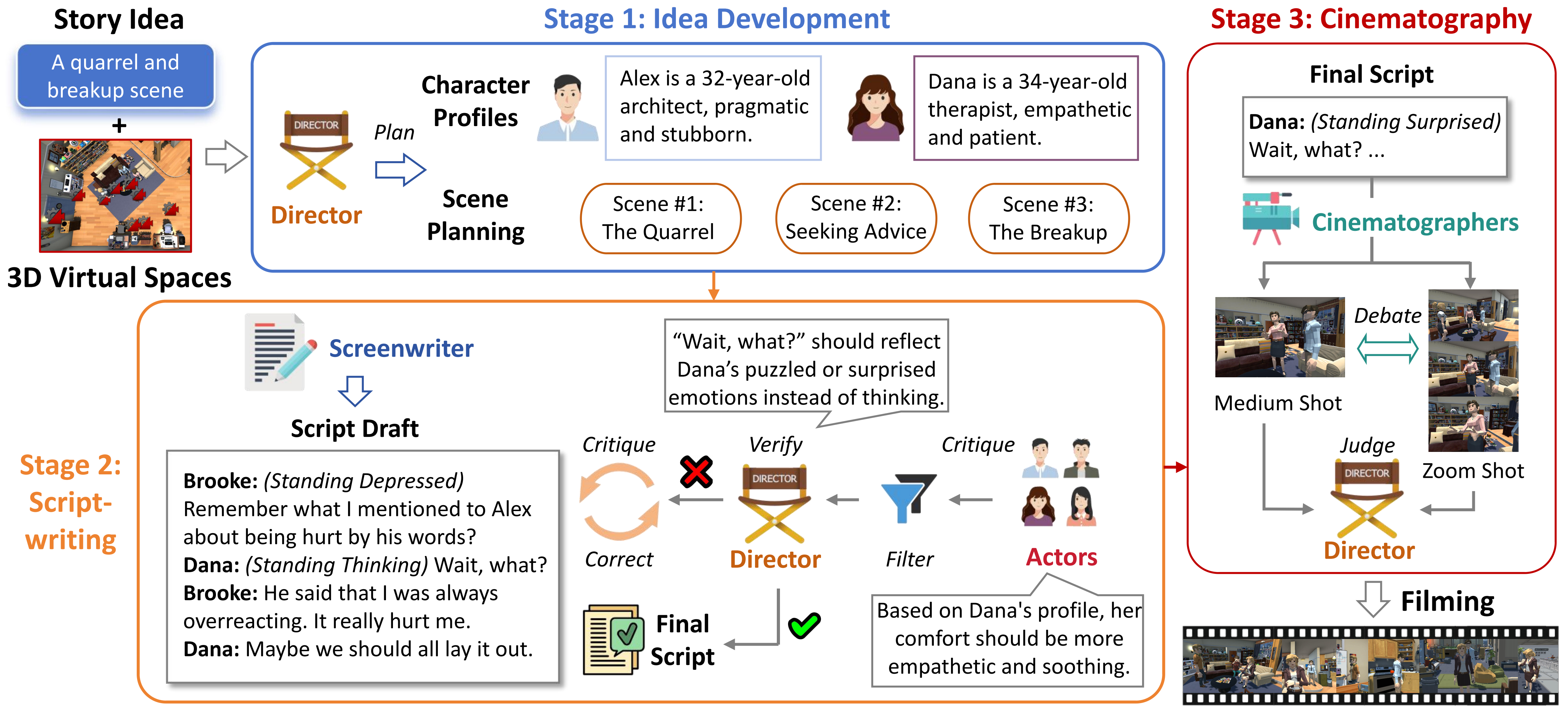 | **[SIGGRAPH Asia 2024] FilmAgent: Automating Virtual Film Production Through a Multi-Agent Collaborative Framework**
*Zhenran Xu, Jifang Wang, Longyue Wang, Zhouyi Li, Senbao Shi, Baotian Hu, Min Zhang*
[[Paper](https://doi.org/10.1145/3681758.3698014)] [[GitHub](https://github.com/HITsz-TMG/Video-Claw/blob/main/FilmAgent.md)] |
|  | **[SIGGRAPH Asia 2024] Anim-Director: A Large Multimodal Model Powered Agent for Controllable Animation Video Generation**
*Yunxin Li, Haoyuan Shi, Baotian Hu, Longyue Wang, Jiashun Zhu, Jinyi Xu, Zhen Zhao, Min Zhang*
[[Paper](https://doi.org/10.1145/3680528.3687688)] [[GitHub](https://github.com/HITsz-TMG/Anim-Director/tree/main/Anim-Director)] |
| 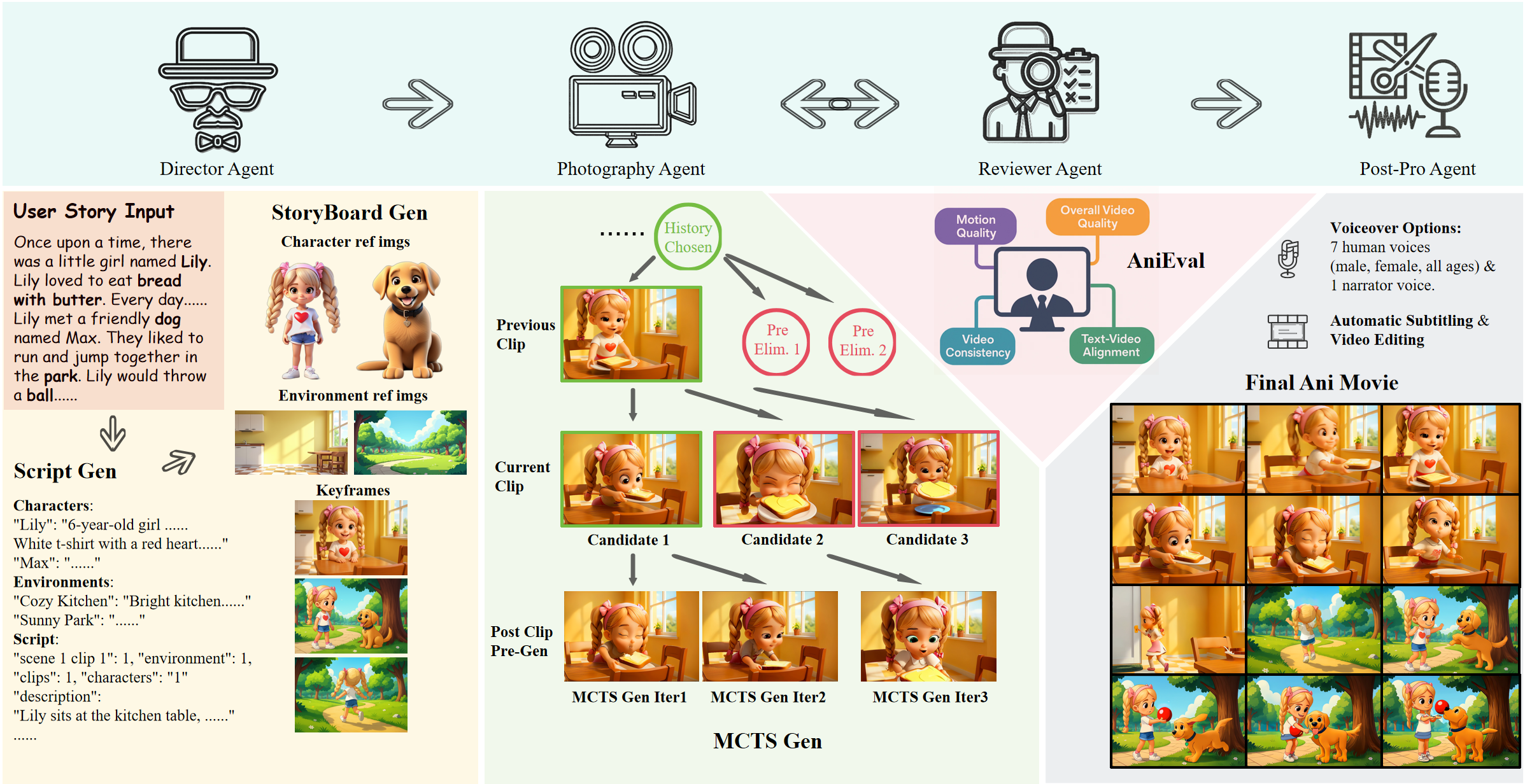 | **[SIGGRAPH Asia 2025] AniMaker: Multi-Agent Animated Storytelling with MCTS-Driven Clip Generation**
*Haoyuan Shi, Yunxin Li, Xinyu Chen, Longyue Wang, Baotian Hu, Min Zhang*
[[Paper](https://doi.org/10.1145/3757377.3764009)] [[GitHub](https://github.com/HITsz-TMG/Anim-Director/tree/main/AniMaker)] |
Built with 🦞 by the Lychee Agent team