
简体中文 | English


Talk to OpenClaw directly: "Generate a video about X" -> done.
2026/3/27: 🎬 AIGC-Claw was officially released, supporting an automated workflow from idea to finished video.2026/4/6: 🎭 AIGC-Claw v2 was released, optimized for short drama generation.2026/4/9: ♾️ AIGC-Claw v3 was released, adding infinite continuation and customizable plot development.2026/4/29: 🧩 Added three one-shot Pipelines: Artistic Short Video, Action Transfer, and Digital Human Talking Video, together with one-click installation.2026/5/8: ⚙️ Added WebUI configuration for API keys and default models, with one-click installation support.2026/5/13: 🎞️ Integrated Pixelle-Video HTML templates into the Artistic Short Video Pipeline.2026/5/14: 🎉 AIGC-Claw has been officially renamed Video-Claw 
Video-Claw is an AI director system for creative video production. You only need to provide an idea, a story outline, or even a vague concept. The system will break it down into an executable filmmaking workflow, continuously producing intermediate assets that can be reviewed, confirmed, revised, and delivered, until a complete final video is generated.
It is not a one-shot text-to-video tool. It is a full production line covering script planning -> character and scene design -> storyboard planning -> reference image generation -> video generation -> post-production editing. Instead of giving you a black-box result, Video-Claw behaves like a collaborative AI directing team: each stage informs the next, and every key node is visible, editable, and extensible.
In addition to the main workflow, Video-Claw provides three one-shot Pipelines for lighter and more direct generation tasks: Artistic Short Video, Action Transfer, and Digital Human Talking Video. Pipeline tasks push progress and artifacts in real time, and generated results plus history records are kept locally for review, deletion, and reuse.
| Stage | Demo | Description |
|---|---|---|
| Home |  |
System overview, supporting project history, creation of new projects, and global settings (API Keys and default models). |
| Script Planning |  |
Enter ideas or outlines to automatically generate structured multi-scene scripts (including narration and dialogue), supporting intelligent plot continuation. |
| Character/Scene Design |  |
Automatically extract key characteristics of roles and settings from the script to generate consistent style reference art. |
| Storyboard Planning |  |
Break down each scene into consecutive visual shots, detailing camera angles, action descriptions, and reference content. |
| Reference Image Generation |  |
Generate high-quality reference images for each shot to precisely control lighting and composition as a key visual benchmark for video generation. |
| Video Generation |  |
Utilize state-of-the-art video models (e.g., Wan, Kling) to convert shots into dynamic clips, with support for action transfer from external videos. |
| Final Editing |  |
Automatically aggregate all generated video clips, render TTS voiceovers, add background music and subtitles, and export the final publishable video. |
Generated with deepseek-v4 + gpt-image-2 + happy-horse-1.0
| ▶️ Breaking the Wall |
▶️ Breaking the Wall (Original Quality) |
8 episodes in total, an underdog story with twists and reversal. The first 6 episodes were generated initially, followed by 2 continued episodes.
| ▶️ Episode 1 Laid Off |
▶️ Episode 2 Late-Night Departure, First Breakthrough |
▶️ Episode 3 AI Funding, Old Employer in Crisis |
▶️ Episode 4 Acquiring Xingyao |
| ▶️ Episode 5 Acquisition, Liquidation, New Life |
▶️ Episode 6 New Life, Looking Back |
▶️ Episode 7 Technology Backfires |
▶️ Episode 8 Upholding Ethics, Getting Through Together |
5 episodes in total, a tribute to the inheritance of civilization.
| ▶️ Episode 1 The Last Lesson |
▶️ Episode 2 The Cleansing Plan |
| ▶️ Episode 3 A Dying Entrustment |
▶️ Episode 4 Questions of Life and Death |
| ▶️ Episode 5 Light of Civilization |
| London Mystery |
A Dog's Purpose |
Drone Delivers Lychees |
 |
 |
 |
 |
 |
 |
 |
 |
| Pipeline | Demo | Frontend Entry | Description |
|---|---|---|---|
|
Artistic Short Video
|
 |
Sidebar: "Artistic Short Video" | Supports both "Image Montage / Dynamic Video" and "Creative Inspiration / Full Script" modes. The system splits narration by periods, generates an image and voiceover for each segment, then either composes image-based clips or calls an image-to-video model for dynamic segments. Optional title and subtitles are supported. |
|
Action Transfer
|
 |
Sidebar: "Action Transfer" | Takes a reference image, an action video, and a prompt, then calls a video model with action-transfer capability to generate the result video. |
|
Digital Human Talking Video
|
 |
Sidebar: "Digital Human Talking Video" | Takes a character image and talking script, generates sentence-level speech and digital human video clips, uses the previous clip's tail frame to continue multi-clip generation, and replaces the final video audio with the generated speech. |
| ▶️ Mountain and River Dreams |
▶️ The Vastness of Life |
| 🖼️ Input Image (Lemon Rat) |
🎬 Input Reference Video |
🚀 Generation Result |
| Capability | Description |
|---|---|
| 🎬 End-to-end generation from idea to final cut | Connects scripts, characters, storyboards, reference images, video clips, and post-production into one complete workflow, upgrading scattered generation abilities into a full video production pipeline. |
| 🖼️ Storyboard-driven controllable creation | Uses structured scripts, storyboard planning, and reference image generation to make character consistency, shot expression, and visual style more stable and controllable. |
| ✍️ Editable, continuable, and regenerable | Supports intelligent continuation of plots and storyboards, while also allowing character, reference image, and video stages to be edited and regenerated without starting from scratch. |
| 🧩 Lightweight Pipeline tasks | Supports Artistic Short Video, Action Transfer, and Digital Human Talking Video as one-shot tasks for fast image/video shorts, action-transfer videos, and talking-head videos. |
| 🏷️ Model capability tag filtering | Backend model metadata is registered in models/config_model.py, and available models are filtered by capability tags such as text, image, video, TTS, and action transfer. |
| 📡 Real-time task status and artifact management | Pipeline pages subscribe to task events for progress and artifacts. History records are grouped by feature and support deleting both task metadata and output folders. |
| 📲 Local deployment, multi-platform collaboration, and asset retention | Supports Web UI, WeChat / Feishu collaboration, OpenClaw Skill integration, and full-chain retention of scripts, images, video clips, and final outputs. |
Linux / MacOS:
# 1. Clone the repository
git clone https://github.com/HITsz-TMG/VideoClaw.git
cd VideoClaw

# 2. Enter the app directory and run the installer
cd video-claw/video-claw
chmod +x install.sh
./install.sh

# 3. back to root dir
cd ../..
Windows:
# 1. Clone the repository
git clone https://github.com/HITsz-TMG/VideoClaw.git
cd VideoClaw

# 2. Enter the app directory and run the installer
cd video-claw\video-claw
install.bat

# 3. back to root dir
cd ../..
The installer checks Python, Node.js, npm, and ffmpeg, installs backend and frontend dependencies, copies backend/config.yaml.example to backend/config.yaml, and builds the frontend. After installation, fill in model service API keys in backend/config.yaml and confirm the main-workflow default models under models. You can also start the frontend and edit these settings from the "Settings" page at the bottom of the sidebar. Then start the services:
# Start backend
cd video-claw/video-claw/backend
uv run python api_server.py

# Start frontend in a new terminal
cd video-claw/video-claw/frontend
npm start
By default, the backend runs at http://localhost:8000, and the frontend runs at http://localhost:3000.
If you only want to install dependencies and skip the frontend build temporarily, run:
AIGC_DIRECTOR_SKIP_FRONTEND_BUILD=1 ./install.sh
# 1. Clone the repository
git clone https://github.com/HITsz-TMG/Video-Claw.git
cd Video-Claw

# 2. Configure and start the backend
cd video-claw/video-claw/backend

# Install backend dependencies
uv sync

# Configure backend YAML
cp config.yaml.example config.yaml
# Edit config.yaml, fill in API keys, and confirm main-workflow default models
# You can also use the frontend Settings page after startup

# Start backend
uv run python api_server.py
# Service runs at http://localhost:8000
# 3. Configure and start the frontend in a new terminal
cd video-claw/video-claw/frontend
npm install
npm run build
npm start
# Visit http://localhost:3000
If uv is not installed, you can also create a Python virtual environment manually and install backend dependencies with pip install -r requirements.txt.
Send this message to OpenClaw:
Please clone this git repository: https://github.com/HITsz-TMG/Video-Claw.git
Then recursively copy the video-claw folder inside Video-Claw to .openclaw/workspace/skills and use it as an AIGC-related skill.
When using it, it is recommended to explicitly say "use video-claw":
Use video-claw to generate a video with the content "A Dog's Purpose".
Make sure clawhub-cli is installed locally.
Open a terminal and run the following command. Choose yes for every prompt.
clawhub install video-claw
After installation, ClawHub will copy video-claw into workspace/skills or your specified skills directory.
Then you can follow Method 1 for one-click installation or Method 2 for manual setup, or let OpenClaw build and run the project for you.
The first time you use video-claw, if the project has not been built manually, OpenClaw will automatically build and start both the backend and frontend. This may take some time because setup involves dependency installation and compilation.
Backend configuration is stored in video-claw/backend/config.yaml using a lowercase hierarchical YAML structure. You can edit this file directly, or open the frontend "Settings" page from the bottom of the sidebar.
api_providers stores API keys, base URLs, and proxy toggles for each model provider.models stores default models for the main workflow home page. When creating a project, the frontend reads these defaults first and sends the concrete model parameters to the backend. The backend no longer silently chooses fallback models for the main workflow; missing model parameters will return an error.After starting both the backend and frontend, open the "Settings" page from the bottom of the left sidebar. You do not have to edit YAML manually for common configuration:
base_url, enable_proxy, and the shared proxy address api_providers.common.proxy.llm, vlm, image_t2i, image_it2i, video, video_ratio, and eval.backend/config.yaml. API keys, proxy settings, and default models are read by newly created projects; service startup fields such as server.host and server.port require restarting the backend to fully take effect.project_name: Video-Claw
server:
host: 127.0.0.1
port: 8000
debug: false
api_providers:
common:
print_model_input: false
proxy: ''
openai:
api_key: your_openai_key
base_url: https://api.openai.com/v1
enable_proxy: false
gemini:
api_key: your_gemini_key
base_url: https://generativelanguage.googleapis.com/v1beta
enable_proxy: false
deepseek:
api_key: your_deepseek_key
base_url: https://api.deepseek.com/v1
enable_proxy: false
dashscope:
api_key: your_dashscope_key
base_url: https://dashscope.aliyuncs.com/api/v1
enable_proxy: false
ark:
api_key: your_ark_key
base_url: https://ark.cn-beijing.volces.com/api/v3
enable_proxy: false
kling:
access_key: your_kling_access_key
secret_key: your_kling_secret_key
enable_proxy: false
models:
llm: qwen3.5-plus
vlm: qwen3.5-plus
image_t2i: doubao-seedream-5-0-260128
image_it2i: doubao-seedream-5-0-260128
video: wan2.7-i2v
video_ratio: '16:9'
eval: qwen3.5-plus
api_providers.common.proxy is the only proxy address. Each provider decides whether to use it via enable_proxy, which is disabled by default, so different model calls in the same process do not pollute each other. Changes to service startup fields such as server.host and server.port require restarting the backend to fully take effect. API keys, proxy settings, and main-workflow defaults under models are read by new project creation and model calls.
| Provider | Config fields | Common use |
|---|---|---|
| OpenAI | api_providers.openai.api_key / base_url |
GPT text/vision models and OpenAI image models |
| Gemini | api_providers.gemini.api_key / base_url |
Gemini text and vision models |
| DeepSeek | api_providers.deepseek.api_key / base_url |
DeepSeek text models |
| DashScope | api_providers.dashscope.api_key / base_url |
Qwen, Wan image/video models, and related Alibaba Cloud services |
| Volcengine ARK | api_providers.ark.api_key / base_url |
Seedream image models and Seedance video models |
| Kling | api_providers.kling.access_key / secret_key / base_url |
Kling video generation |
You only need to fill in the provider keys required by the models you choose. For example, if the main workflow uses a doubao-seedream-* image model, configure ark.api_key; if it uses a wan* video model, configure dashscope.api_key. If you choose different models on a Pipeline page, make sure the corresponding provider key is also configured.
| Type | Models |
|---|---|
| LLM | qwen3.6-max-preview, qwen3-max, deepseek-chat, deepseek-reasoner, deepseek-v4-flash, deepseek-v4-pro, gpt-4o, gpt-5, gpt-5.4, gemini-2.5-flash, gemini-2.0-flash, kimi-k2.6 |
| VLM | qwen3.6-plus, qwen3.6-flash, kimi-k2.6, gpt-5.4, gemini-2.5-flash-image, gemini-2.0-flash |
| Text-to-Image | wan2.7-image, wan2.7-image-pro, wan2.6-t2i, doubao-seedream-5.0/4.5/4.0, gpt-image-2 |
| Image-to-Image | wan2.7-image, wan2.7-image-pro, doubao-seedream-5.0/4.5/4.0, gpt-image-2 |
| Video Generation | wan2.7-i2v, wan2.6-i2v-flash, doubao-seedance-2.0 (Normal/Fast), kling-v3/v2.6/v2.5 |
Model information is defined in video-claw/video-claw/backend/models/config_model.py. The frontend and Pipeline APIs filter models by capability tags, such as text generation, image generation, image-to-video, action transfer, and TTS.
All tasks metadata and generated artifacts are stored under video-claw/video-claw/backend/code/.
video-claw/video-claw/backend/code/
├── data/
│   ├── tasks/                  # Pipeline task metadata (JSON)
│   └── sessions/               # AIGC-Claw session metadata (JSON)
└── result/
    ├── task/                   # Pipeline generated artifacts (by Task ID)
    │   └── <task_id>/          # e.g., 20260514_204946_961f95d9
    │       ├── audio_xx.mp3    # Audio segments
    │       ├── video_xx.mp4    # Video segments
    │       ├── storyboard.json # Storyboard data
    │       └── final.mp4       # Final combined video
    ├── image/                  # AIGC-Claw generated images
    │   └── <session_id>/       # By Session ID
    │       ├── Assets/         # Character and setting assets
    │       │   ├── characters/ # Character reference images
    │       │   └── settings/   # Setting reference images
    │       └── Scenes/         # Generated storyboard reference images
    ├── video/                  # AIGC-Claw generated videos
    │   └── <session_id>/       # By Session ID
    └── script/                 # AIGC-Claw generated script/storyboard data
YYYYMMDD_HHMMSS_RandomHash (e.g., 20260514_204946_961f95d9), used to uniquely identify a Pipeline task.1778810088325), used to associate interaction context and generated images in the main workflow.The idea and design of Video-Claw were inspired by AutoResearchClaw, huobao-drama, LibTV, and libtv-skills.
Pixelle-Video: Video-Claw draws on its Artistic Short Video, Action Transfer, and Digital Human Talking Video Pipelines, as well as its HTML template approach for precise text control in images and videos.
| Framework | Paper Information |
|---|---|
 |
[SIGGRAPH Asia 2024] FilmAgent: Automating Virtual Film Production Through a Multi-Agent Collaborative Framework *Zhenran Xu, Jifang Wang, Longyue Wang, Zhouyi Li, Senbao Shi, Baotian Hu, Min Zhang* [Paper] [GitHub] |
 |
[SIGGRAPH Asia 2024] Anim-Director: A Large Multimodal Model Powered Agent for Controllable Animation Video Generation *Yunxin Li, Haoyuan Shi, Baotian Hu, Longyue Wang, Jiashun Zhu, Jinyi Xu, Zhen Zhao, Min Zhang* [Paper] [GitHub] |
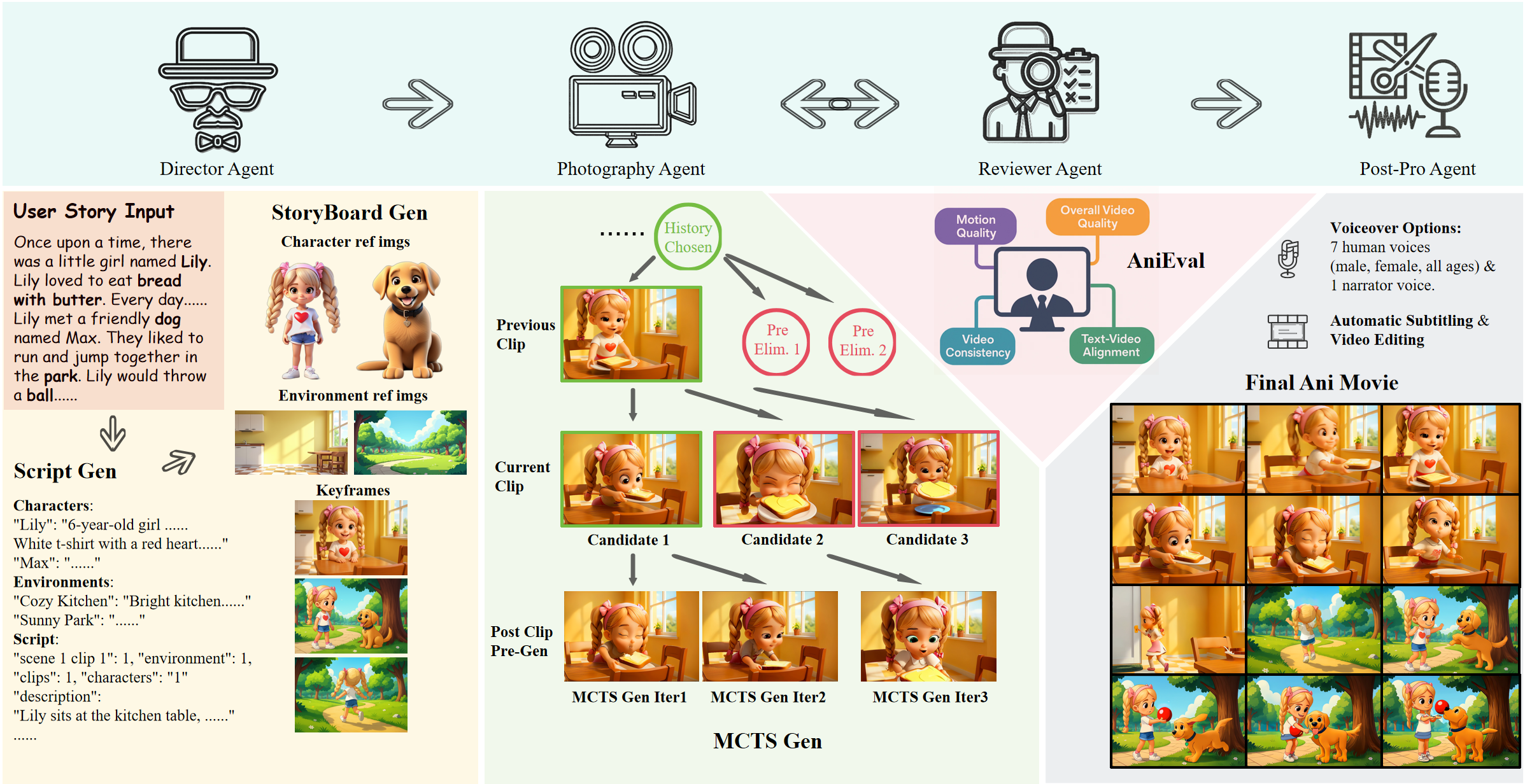 |
[SIGGRAPH Asia 2025] AniMaker: Multi-Agent Animated Storytelling with MCTS-Driven Clip Generation *Haoyuan Shi, Yunxin Li, Xinyu Chen, Longyue Wang, Baotian Hu, Min Zhang* [Paper] [GitHub] |
Built with 🦞 by the Lychee Agent team

